"But it is not peer reviewed"
The dirty reality behind this stupid narratives

This substack goes out for people who don’t read the papers but “trust in science”™. If you say “it is not peer reviewed” then you should at least know what’s behind a peer review.
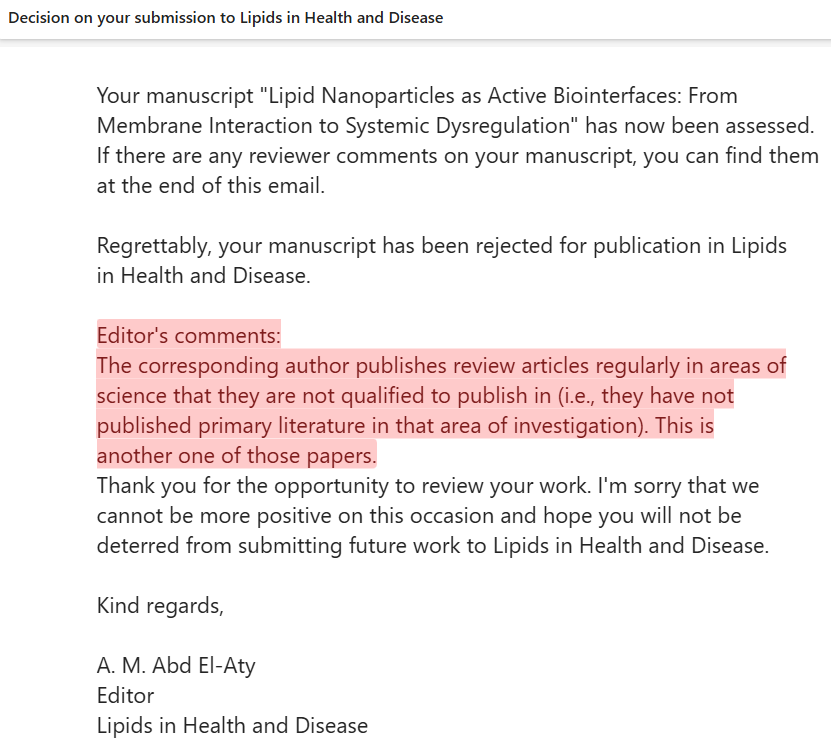
Our new review manuscript “Lipid Nanoparticles as Active Biointerfaces: From Membrane Interaction to Systemic Dysregulation”1 (lead authors: Falko Seger & Maria Gutschi, with Stephanie Seneff) has just been rejected by the Springer Nature journal Lipids in Health and Disease without external reviewers, without criticism of the content, simply by desk rejection.
P.s.: We’re continuing the fight to get our “beast” published.
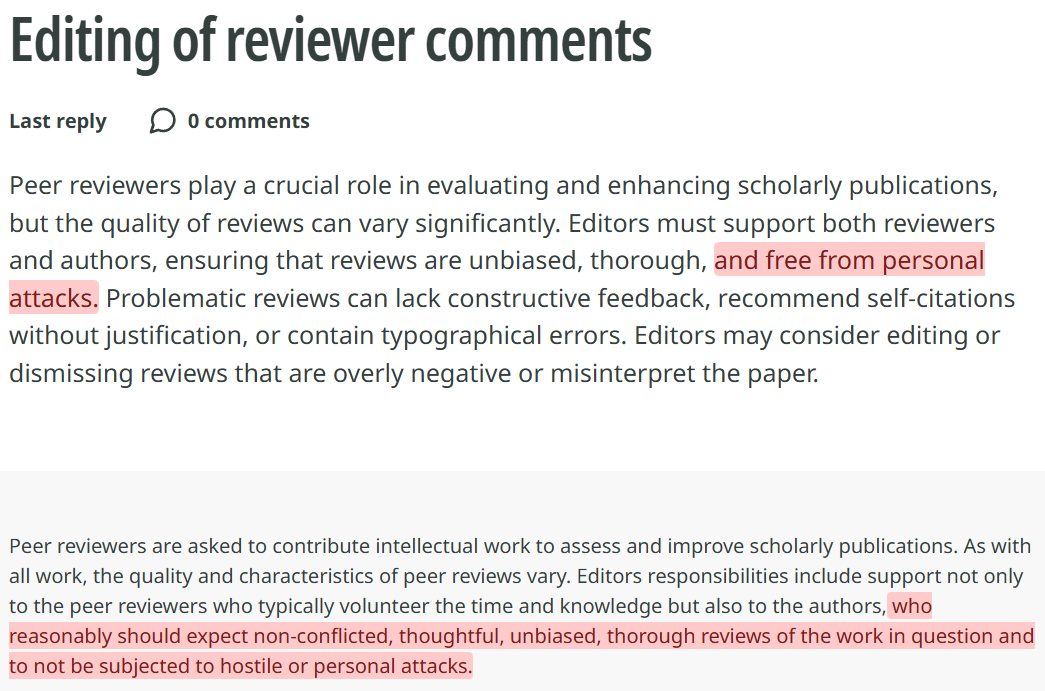
Springer/Nature has clearly committed itself to COPE2 for each individual journal under its publishing policy3.
Could someone please explain to me how this rejection was constructive and unbiased, and not merely a personal attack? The editor-in-chief who gave the response even ignores the fact that there are one other main authors besides Stephanie Seneff as project manager and myself. As far as I understand COPE, it is not permissible to reject an author on the basis of lack of education and/or affiliation, nor on the basis of controversial media reports. Stephanie’s work is not being rejected, and her name and expertise are highly valued, even if her ideas are controversial. Science thrives on controversial perspectives. It is not about the fact that we were rejected, but about how:
Let us summarize first what a review does and what you need for doing a review and an integrated hypothesis:
A synthesis of existing literature
A critical evaluation
A systematic compilation
With conclusions and classification
This requires:
Expertise
Analytical thinking skills
Literary competence
A university degree is not necessary for this.
In science, it is the manuscript that counts, NOT the educational background. Peer review assesses exclusively:
Quality of the text
Scientific accuracy
Logic of the argumentation
Quality of the literature review
Structure, clarity, completeness
The following may not be assessed:
Academic titles
Professional status
Degree
Institutional affiliation
Personal opinions about “qualification”
This statement contradicts all good practices of scientific principles, especially the principle of interdisciplinary research. Many important reviews deliberately arise from borderline areas:
Computer scientists write reviews on bioinformatics.
Physicists write reviews on systems biology models.
Mathematicians write reviews on epidemiological dynamics.
Doctors write reviews on philosophical or ethical questions.
Immunologists write reviews on oncology—and vice versa.
The claims of this editor are like: “It is you not allowed if you’re not from the field, to do the conclusions nobody before did. You’re simply unworthy.” I wonder if he could refute a single thought we’re drawing from the literature we quote?
Seger, F., Gutschi, L. M., & Seneff, S. (2025). Lipid Nanoparticles as Active Biointerfaces: From Membrane Interaction to Systemic Dysregulation. https://doi.org/10.20944/preprints202511.0517.v2