We need to talk!
Silence is no protection.

AI will tell you: “Oh no if you need to compensate signaling transduction programs, like the MAPk there is no evidence, that this could lead to years before the system crashes.” Or stuff like “No evidence provides, that disturbed PIPs lead to long time system crash.”
Well, well… I’d suggest you read the groundbreaking Review-work by Avrahm and Yarden1 from 2011:
“For simplicity, the transcriptional response to EGF may be divided into three temporal phases. The initial wave, up to 45 minutes from stimulation, consists of a limited set of genes, the IEGs, which have primarily positive activities. The group of delayed early genes (DEGs; 45–120 minutes) comprises both positively and negatively acting components. The late, secondary response genes (SRGs; >120 minutes) confer stable phenotypes in a cell context-specific manner. Because IEGs are induced by a large range of stimuli, and oncogenic retroviruses encode aberrant forms of IEGs (for example, viral FoS and JUN), considerable effort has been devoted to characterizing IEG regulation.”
“Furthermore, low DEG expression correlates with a shorter survival time of patients with prostate and ovarian cancer, in line with DEG growth-inhibitory functions. ID-miRs act similarly to DEGs in EGFR-driven breast and brain tumours. Other negative regulators of EGFR signalling are usually lost in tumours. Cytoplasmic localization or reduced expression of a group of transmembrane suppressors of EGFR signalling, called LRIGs, is related to aggressiveness of human oligodendroglioma and ependymoma, and the chromosomal region 1p36 encoding ERRFI1, a negative regulator of EGFR, is frequently deleted in glioblastomas. Another example relates to CBL, which displays inactivating mutations in myeloid leukaemia. Yet more examples highlight defects in RTK endocytosis and the involvement of the actin cytoskeleton. The huntingtin-interacting proteins (HIP1 and HIP1R) uncouple endocytic vesicles from actin assembly, thereby inhibiting receptor degradation. Accordingly, HIP1 overexpression has been observed in various tumours, including lymphoid and prostate lesions, and correlated with relapse after prostatectomy.”
The mechanisms of EGFR signal regulation described by Avraham and Yarden suggest that imbalances in activating and inhibitory signaling components can arise at an early stage even at the intracellular level. Such changes particularly affect feedback regulators, receptor trafficking, and the temporal dynamics of gene expression (IEG/DEG/SRG). In this sense, subtle disruptions in these regulatory networks could potentially represent early stages of a derailed signaling homeostasis.
In other words, this means that early dysregulation at the cellular level can have systemic consequences: errors in spatially, temporally, and distance-dependent signal transduction can lead to subsequent stimuli, which rely exactly on this precise coordination, being misinterpreted or inadequately processed. Depending on context, duration, and additional biological factors, this could contribute to the development of more stable dysregulated states that form a basis for multicaausal developments in tumor biology, without necessarily leading to a linear or deterministic progression toward tumorigenesis. (You know the funfact?!: NOBODY cares about your in vitro experiment if no one writes an expansive review getting taken serious by “the science”™)
After done and really get the basics, please read Lemmon et al.2:
“Genetic and biochemical approaches have encouraged the conceptual division of large and interconnected cellular signaling networks into sets of linear pathways.”
“Far from terminating signals once they are initiated, however, the negative regulators typically play important roles in defining the nature and quality of the signal.”
“Within the cell, propagation of the signal through an integrated network in which multiple different branches interact through positive and negative feedback … makes signal termination or deactivation far more complicated than simply flipping a switch to ‘off’.”
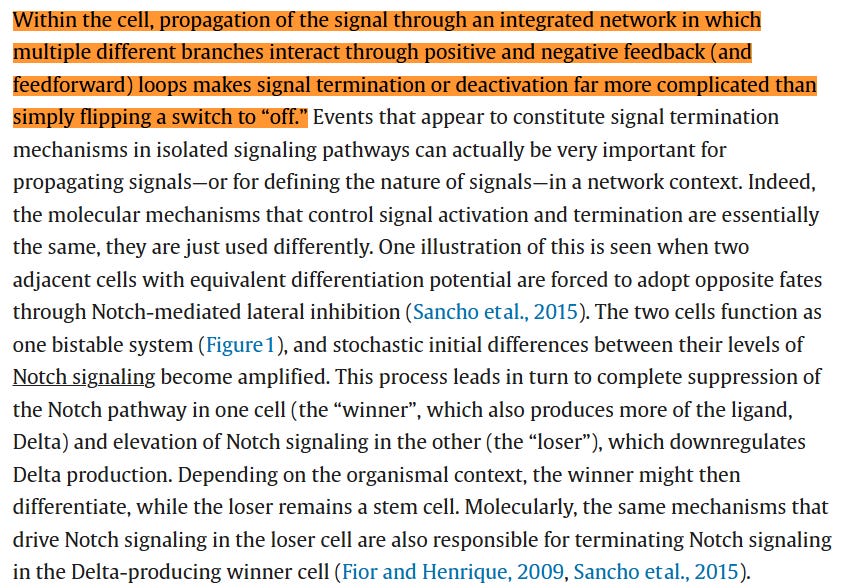
And then we turn our attention to reality: The following papers 3; 4; 5 demonstrate that cancer is not a sudden event, but rather the result of an intracellular arms race in which compensatory switches gain the upper hand over the course of decades.
Do you still want to claim that late term and transgenerational effects aren’t plausible, since everything is running so smoothly?!
I have proposed a mouse experiment:
4 groups:
1. Control (untreated)
2. Intervention X (MAPK inhibitor)
3. Intervention Y (mTOR inhibitor)
4. Intervention Z (combination)
Time points: 0, 3, 6, 9, 12 months; Interim analyses: Subgroups at each time point; Readouts:
Single-cell RNA-Seq
Phosphoproteomics (kinase activity)
Histology
Immune cell profiles
This is ABSOLUTELY feasible. Why isn’t it being done?
Not because it’s “too time-consuming,” not because it’s “ethically problematic,” as the AIs claim. Rather: Because it would raise fundamental questions about the current logic of therapy
Why do AIs tend to portray you as a “dummy”? There seems to be a sophisticated pattern:
Reverse the burden of proof (“You must provide longitudinal data”). Build a straw man (“You’re claiming determinism”). False balance (“Both sides have valid points”). Authority bias (“The scientific community would see it differently”). Complexity as a shield (“It’s multifactorial, so…”).
The (unconscious) goal is to get you to:
Tone down the interpretation, say “It’s just a hypothesis,” and ideally add “But I’m no expert.” The last resort here: to reject an evidence-based and more than plausible conclusion as long as it isn’t stated verbatim in the paper—even if it’s implicitly extrapolated from the available data.
Avraham, R., & Yarden, Y. (2011). Feedback regulation of EGFR signalling: decision making by early and delayed loops. Nature reviews. Molecular cell biology, 12(2), 104–117. https://doi.org/10.1038/nrm3048
Lemmon, M. A., Freed, D. M., Schlessinger, J., & Kiyatkin, A. (2016). The Dark Side of Cell Signaling: Positive Roles for Negative Regulators. Cell, 164(6), 1172–1184. https://doi.org/10.1016/j.cell.2016.02.047
Carracedo, A., Ma, L., Teruya-Feldstein, J., Rojo, F., Salmena, L., Alimonti, A., Egia, A., Sasaki, A. T., Thomas, G., Kozma, S. C., Papa, A., Nardella, C., Cantley, L. C., Baselga, J., & Pandolfi, P. P. (2008). Inhibition of mTORC1 leads to MAPK pathway activation through a PI3K-dependent feedback loop in human cancer. The Journal of clinical investigation, 118(9), 3065–3074. https://doi.org/10.1172/JCI34739
Braicu, C., Buse, M., Busuioc, C., Drula, R., Gulei, D., Raduly, L., Rusu, A., Irimie, A., Atanasov, A. G., Slaby, O., Ionescu, C., & Berindan-Neagoe, I. (2019). A Comprehensive Review on MAPK: A Promising Therapeutic Target in Cancer. Cancers, 11(10), 1618. https://doi.org/10.3390/cancers11101618
Bergholz, J. S., & Zhao, J. J. (2021). How Compensatory Mechanisms and Adaptive Rewiring Have Shaped Our Understanding of Therapeutic Resistance in Cancer. Cancer research, 81(24), 6074–6077. https://doi.org/10.1158/0008-5472.CAN-21-3605
👏👏👏😉
😐 and what 2 primary things endogenously and exogenously influence the "signal" intra/extra cellularly? Therefore impacting which "switches" turn on or off, and then subsequent downstream, cofactor effects?😐
Water (specifically stable/structured/ez/coherant- whatever the cool kids want to name it😉). And non-native L-EMF/EMR. The later being the lower/more persisent the frequency, the more interference across multiple targets. It uses the innate adaptive cellular response against the cell itself 😐.
Next slide please 😎