Flach et al.
Retrospective dogamtism: How to sell crap

Introduction
The reason for introducing the work of Flach et al. (2011) is not because aluminium hydroxide adjuvants and lipid nanoparticles (LNPs) represent identical biological systems, but because their study revealed a deeper mechanistic principle that became apparent only when viewed through the lens of our LNP-focused investigation. While our original focus was directed toward understanding whether LNPs function merely as passive delivery vehicles or as biologically active membrane interfaces, the findings of Flach et al. provided an unexpected historical and conceptual connection: they demonstrated that membrane organization itself can act as a fundamental regulator of cellular signalling.
This realization is important because it shifts the discussion away from technology-specific mechanisms and toward a more general principle of cellular biology. Flach et al. showed that immune activation could arise from direct biophysical modulation of membrane architecture rather than exclusively through classical biochemical receptor interactions. When considered alongside modern lipid-based platforms, this observation suggests that membrane organization represents a previously underestimated regulatory layer, one in which lipid composition, cholesterol distribution, electrostatic properties, phosphoinositide dynamics, and spatial receptor organization collectively influence cellular information processing.
Therefore, presenting Flach et al. at this stage is essential because their work provides an independent historical example supporting a broader hypothesis: that engineered lipid systems such as LNPs must be understood not only through their molecular cargo, but also through their capacity to interact with and potentially reshape the membrane environment in which cellular signalling is organized. Their study represents a conceptual bridge between classical adjuvant biology and modern membrane-engineering technologies, revealing that the membrane itself may be one of the most important biological interfaces governing immune activation, signalling fidelity, and cellular homeostasis.1
Flach et al
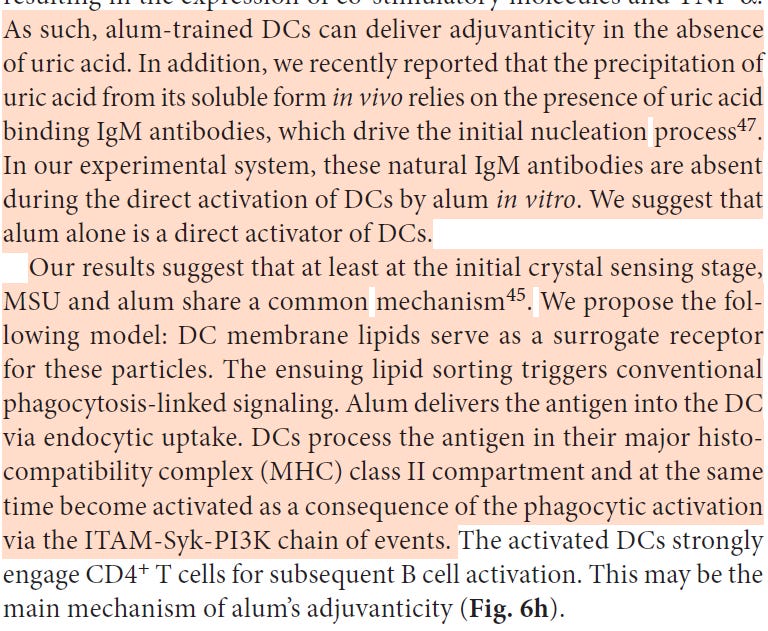
For more than 80 years, aluminium hydroxide (“alum”) was the most widely used adjuvant worldwide. The prevailing scientific view long maintained that alum functioned primarily through a harmless “depot effect” or through the engagement of specific pattern-recognition receptors (PRRs).
Flach et al. challenged this concept in 2011 with an elegant biophysical analysis that fundamentally changed the understanding of alum-mediated immune activation. Their work demonstrated that alum does not require uptake or phagocytosis by dendritic cells in order to induce strong immune stimulation. Furthermore, its activity does not depend on classical PRRs or conventional biochemical lock-and-key receptor interactions.
Instead, alum acts through direct physical interactions with the cell membrane. It binds with high affinity to specific membrane components, particularly sphingolipids and cholesterol located in the outer leaflet of the plasma membrane. This physical anchoring induces rapid lipid reorganization and aggregation of membrane domains commonly referred to as lipid rafts. The resulting structural deformation of the membrane initiates intracellular signalling cascades that ultimately promote T-cell activation.
The central implication of Flach et al. (2011) was that the initiation of adjuvant sensing does not necessarily require a conventional protein-based receptor interaction. Instead, membrane lipid organization can serve as an upstream recognition layer that initiates downstream signalling cascades.
This finding provided a broader conceptual framework for understanding a much larger class of adjuvant technologies. Flach et al. effectively revealed a general principle: adjuvants may operate not only as molecular signalling agents but also as physical modulators of cellular membranes.
When this mechanism is considered in relation to newer, more complex adjuvant systems, including saponin-based formulations such as QS-21, liposomal complexes, polymeric nanoparticles, and lipid nanoparticles (LNPs)—a broader continuum of membrane interaction becomes apparent.
Where alum primarily acts at the membrane surface by inducing lipid-domain rearrangement, more advanced delivery systems can interact with membranes in additional ways. Some nanoparticle-based platforms are designed to facilitate membrane fusion, cellular entry, endosomal escape, or intracellular cargo delivery. These processes involve substantial alterations of membrane organization, lipid distribution, electrostatic interactions, and intracellular trafficking pathways.
This creates a continuum between intended immune stimulation and potential cellular stress. A controlled biophysical disturbance may serve as an immune “danger signal,” whereas excessive or poorly regulated membrane perturbation can interfere with essential cellular processes. These processes include membrane homeostasis, phosphoinositide signalling pathways, intracellular trafficking, and repair mechanisms such as ESCRT-mediated membrane restoration.
From this perspective, a common theme among different adjuvant classes is not simply the presentation of a biochemical stimulus, but the induction of a physical state of cellular stress that the immune system interprets as a signal of danger. The magnitude and consequences of this response depend on the nature, intensity, duration, and cellular context of the membrane interaction.
This perspective also raises fundamental questions about the interpretation of antibody titres as the primary measure of vaccine or adjuvant success. An antibody titre reflects the outcome of immune activation, but it does not independently reveal the underlying cellular mechanisms required to generate that response.
If adjuvant activity involves membrane deformation, destabilization, or intracellular delivery processes, then a strong antibody response may represent the measurable endpoint of a successful immunological intervention while providing limited information about the broader cellular costs or physiological trade-offs involved.
A narrow focus on antibody titres risks overlooking the biophysical dimension of immune activation. Conventional immunological evaluation often concentrates on downstream outcomes such as B-cell differentiation and antibody production, while giving less attention to possible alterations in membrane organization, lipid metabolism, signalling networks, and cellular repair pathways occurring during the activation process.
How our work may shed light on the past
Only after developing our membrane-centred framework for lipid nanoparticles did we encounter the work of Flach et al. (2011), which provided an unexpected historical perspective on the broader implications of this concept.2 Our original investigation was not derived from alum biology, but from the fundamental question of whether LNPs should be considered passive delivery systems or biologically active membrane interfaces. The findings of Flach et al. subsequently revealed that the principle emerging from our LNP analysis was not necessarily unique to synthetic lipid nanoparticles, but reflected a deeper and more general property of biological membranes.
In this sense, Flach et al. represents a retrospective conceptual connection: an independent example demonstrating that physical organization of the membrane itself can function as a regulator of cellular signalling. Their work suggested that membrane architecture is not merely a passive environment in which biochemical interactions occur, but an active biological interface capable of translating physical alterations into cellular responses. This realization expanded the interpretation of our LNP-focused hypothesis from a technology-specific phenomenon toward a broader framework of membrane-controlled cellular regulation.
Modern nanoparticle-based and membrane-interacting technologies have extended these principles into more sophisticated delivery systems. The resulting scientific challenge is therefore not only to quantify immune activation, but also to understand how engineered biophysical interactions with cells influence the balance between effective immune stimulation, cellular adaptation, and potential biological stress.
Our initial investigation into lipid nanoparticles (LNPs) focused on a fundamental question in modern delivery biology: whether these synthetic lipid systems should truly be regarded as biologically inert carriers whose function is limited to transporting nucleic acid cargo, or whether the lipid structures themselves represent active biological interfaces capable of influencing cellular organization. During the development of this membrane-centred framework, the work of Flach et al. (2011) on aluminium hydroxide adjuvants revealed an unexpected and highly relevant conceptual connection. Although developed in an entirely different biological context, their findings demonstrated that immune activation could emerge from direct biophysical interactions with membrane architecture rather than solely from classical receptor-mediated biochemical signalling. This realization suggested that the mechanistic principles identified in our LNP-focused analysis may not represent an isolated feature of nanoparticle technology, but rather reflect a more general and fundamental property of biological membranes.
The significance of this connection lies not in the assumption that aluminium hydroxide and lipid nanoparticles operate through identical mechanisms, but in the broader principle they reveal: membrane organization itself represents a critical regulatory layer of cellular function. Flach et al. provided an early example showing that physical modulation of membrane structure can influence immune signalling. When viewed together with the behaviour of modern lipid-based delivery platforms, this observation points toward a more generalizable concept in which lipid composition, membrane domains, electrostatic organization, and phosphoinositide-dependent signalling networks act as active determinants of cellular information processing.
Building upon this broader realization, our work (Seger et al., 2026), “Lipid Nanoparticles as Active Biointerfaces: From Membrane Interaction to Systemic Dysregulation,” addresses what we consider a fundamental blind spot in contemporary pharmacology and vaccinology. The traditional “lipid bag” paradigm, the assumption that the plasma membrane functions primarily as a passive structural envelope, fails to capture the regulatory complexity of the membrane interface. Instead, the membrane should be understood as a dynamic biological control system in which lipid rafts, cholesterol distribution, electrostatic gradients, and phosphoinositide (PI/PIP) organization regulate receptor architecture, signal transduction, gene expression, and cellular adaptation.
This perspective becomes particularly relevant when considering the organization of G protein-coupled receptors (GPCRs), one of the largest signalling receptor families in human biology. The approximately 800 GPCRs do not function as isolated molecular switches determined exclusively by ligand binding, but as membrane-embedded signalling systems whose behaviour depends on multiple contextual parameters, including the surrounding lipid environment, cholesterol status, phosphoinositide composition, interaction partners, and activation state. Consequently, alterations in membrane organization could influence receptor clustering, conformational dynamics, and coupling efficiency to downstream signalling pathways. Because GPCR networks regulate major intracellular cascades, including MAPK signalling, PI3K/AKT/mTORC pathways, and interactions with cytokine-dependent JAK/STAT signalling, disturbances at the membrane level could theoretically propagate through multiple layers of cellular regulation. In this context, membrane architecture represents not merely a structural component, but a critical information-processing layer of the cell.
Within this framework, LNPs represent a particularly important case study because they intentionally introduce synthetic lipid structures into this regulatory environment. The assumption that LNPs function merely as passive “taxis” whose biological relevance ends after cargo delivery overlooks the possibility that the lipid interface itself participates in cellular regulation. Our L-DMD (lipid-nanoparticle-driven membrane dysfunction) model therefore proposes that LNPs should be investigated as active biointerfaces whose physicochemical properties may influence membrane organization independently of their nucleic acid payload.
At the site of interaction, synthetic lipids may modify fundamental membrane properties, including lipid packing, curvature, inner-leaflet electrostatics, cholesterol organization, phosphoinositide distribution, and membrane-associated regulatory processes. These effects are not necessarily equivalent across all formulations or biological contexts, but they highlight a previously underestimated dimension of lipid-based technologies: the biological consequences of the interface itself.
The importance of this membrane-centred perspective becomes apparent when considering downstream signalling consequences. Phosphoinositides act as central organizers of membrane identity, intracellular trafficking, cytoskeletal regulation, and recruitment of signalling proteins. Changes in PIP composition or localization can therefore influence interconnected regulatory pathways, including MAPK, mTORC, and JAK/STAT signalling networks, which collectively control inflammatory responses, metabolic adaptation, stress responses, and cellular fate decisions. Thus, the membrane is not simply the location where signalling begins; it is an upstream regulatory environment that determines how signalling information is generated, amplified, and interpreted.
This framework also highlights the limitations of evaluating complex biological interventions primarily through downstream outputs such as antibody titres. Such measurements capture the final product of immune activation but provide limited insight into the upstream cellular processes required to generate that response. A high-response phenotype does not by itself reveal the biophysical events, membrane adaptations, or signalling reorganizations occurring during activation.
Ultimately, the broader implication emerging from the comparison between LNP biology and earlier membrane-active systems such as alum is that the membrane itself may represent a previously underestimated biological control layer. The relevance of this insight extends beyond any single technology: it challenges the assumption that biological outcomes can be understood exclusively through molecular cargo or receptor-specific signalling. Instead, it emphasizes the need to consider membrane organization, lipid composition, phosphoinositide dynamics, receptor architecture, and downstream signalling networks as interconnected components of cellular regulation.
Flach TL, Ng G, Hari A, et al. Alum interaction with dendritic cell membrane lipids is essential for its adjuvanticity. Nat Med. 2011;17(4):479-487. doi:10.1038/nm.2306
Seger, F., Gutschi, L.M., Seneff, S., 2026. Lipid nanoparticles as active biointerfaces: From membrane interaction to systemic dysregulation. Acta Pharmaceutica Sinica B S2211383526004235. https://doi.org/10.1016/j.apsb.2026.07.001
We should look at polysorbate next. Tween 80 and review Cremaphor EL. That stuff shredded membranes.